


A 2 year milestone for the blog is four articles which featured in local newspaper The Shields Gazette in the last few weeks. Included in the articles are extracts from some of the interviews I’ve done with musicians.
Gary Alikivi February 2019
A 2 year milestone for the blog is four articles which featured in local newspaper The Shields Gazette in the last few weeks. Included in the articles are extracts from some of the interviews I’ve done with musicians.
Gary Alikivi February 2019
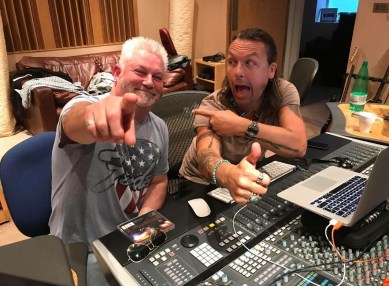
We had John Gallagher from Raven in the studio the other week. He came in to add vocals and bass for something Steve Thompson was putting together. (Steve is a North East songwriter who featured in a post June 27th 2017).
It was amazing. I only heard of Raven when I went to a Slayer gig last November with Anthrax supporting them. They said it ‘was great to be in Newcastle where Venom and Raven came from’. A few month later here he was hanging out in the studio.
I listened to the album, and I could totally see it. When John came in and put the vocal down, he could still do it. He was screaming and held a note for about a minute and the bass, well he was flying all over the place. Yes, he’s still got it.
Steve was putting these songs together for his publishing company and he was having such a good time it’s ended up for an album. He’s done about 15 songs. He likes it here so just kept coming back.
A lot of people do return, we get reviews on social media saying the studio is just nice and relaxed atmosphere.

Who else have you had in the studio ?
Lately we’ve had Newcastle musician Afnan Prince in the studio, also Connor Pattison from Durham. They have an Arctic Monkeys sound.
After some recordings here the file of individual tracks of bass, snare drum, vocals etc get sent to another engineer who puts a sort of extra shine on the mix you know and gets it played on the radio.
We had some kids from Sunderland doing like indie rock which is a big thing. We had a band called Tank Engine in doing a real thrashy rock. They are from Washington and used to be in a band called Your Code Name is Milo who did fairly big thing’s in the 2000s.
The drummer is in a band with tv’s The Hairy Bikers. They are releasing stuff in Spring and I’m really looking forward to it, really interesting band.
I’ve done a lot of rap, so I was producing some beats and people were coming on and rapping on them. There was some acoustic stuff like with singer/songwriter Trev Gibb who has branched out on all sorts of sounds now.
Most of what I do now is the finished product. Radio play, You Tube and Trev’s is for an album.
Most of what I record here end’s up on Radio Newcastle at some point. Some end up on BBC Radio 6. One was for a 15 year old called Tom Smith. He played on all the instruments, and we sent it in and Radio DJ Tom Robinson loved it and played it.
Just this Saturday I had four songs produced here on BBC Newcastle so that was good.


Sounds like the studio is getting a reputation…
Yes it’s building up. Only in the last couple of years it’s started to happen as this has been here about 15 years. First off it was based around a youth club which was a great idea when it was 50p to come in and record. I wouldn’t have started recording if it wasn’t for that.
About 10 years ago Daniel Clifford and I were in a band called Squares and recorded a few EP’s with original engineer John Clavering. We picked up how to record so we made an album.
We didn’t know anything about EQ or compression (laughs). But we learned and I ended up getting a job here.
Do you think there is much original music out there and venues to play ?
As far as I know there is some amazing stuff in the North East. I catch up with it by listening to BBC Radio Newcastle on a Saturday night 8-10pm. That’s their introducing show run by Nick Roberts.
All you have to do is load an mp3 to the introducing site, they have a listen, and your song can go to your local radio or if they really like it a national show like BBC1 Extra.
For venues there is still The Cluny, or The Riverside which is good. The Head of Steam is still going. These are Newcastle but as far as I know nothing in South Shields. You can hire out The Customs House but you’d have to already have a following to do that.
Most pubs are focused on cover bands because that’s what gets people through the doors. I think The Queen Vic were trying out bands but don’t know how that worked. Bands I record haven’t mentioned playing in Shields.
I’m working on putting a funding bid together to organise a live music event mainly for a student audience. Just need to fine tune it.

With home recording made easier why would musicians use this or any studio ?
I love that you can record at home. It’s what I used to do for demos and singles. Had some good sounds recorded in the house. But if you pay what we charge £15 per hour you get access to excellent industry standard microphone’s, guitar amp’s, drum kit to make a big noise which you wouldn’t be able to do in your house. Plus, my years of experience which all counts.
Interview by Gary Alikivi January 2019.
Contact Martin on 0191 456 3917
The Customs Space, Captains Row, South Shields NE33 5AS
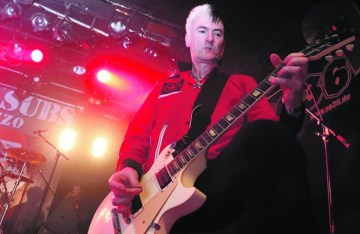
Steve Straughan guitarist with UK Subs got in touch about an ongoing problem of instruments damaged by airlines. An issue that he feels all touring musicians should be aware off…
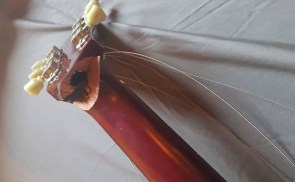
In 2015 the headstock on my Gibson Les Paul Classic was smashed off while in a hard, solid flight case. The guitar was actually in two pieces.
This was the second time it had happened on two different airlines. This was when I decided to take action.
I took to social media and loads of people replied offering good advice. I got in touch with Air France and at first they told me they would not compensate me. Their reason being that the guitar case was not damaged but the guitar was.
So, I sent an email directly to the CEO of the airline and I started receiving offers of compensation from their staff. Eventually I was compensated but it took a long time.
But this was only due to all the good people out there. All the messages of support really helped. It felt like I wasn’t going through the whole process alone.
This is why I set up a facebook page to help others who find themselves in the same unfortunate position. We can take on the big companies if we stick together.
What do you think is the main problem in transporting your instruments ?
On top of the lack of storage issue there is the on-going problem of the instruments being smashed by the baggage handlers and left in the airport or even sent to the wrong airport.
It’s also a hard fight to get any compensation for damaged instruments. It’s becoming very difficult for musicians.
Airlines have lost my guitar twice. There was one concert in Budapest and another in Spain where I had to use another musician’s guitar. I often get messages saying it’s happened to them.
Is this being addressed by the airlines and can you see it becoming a bigger problem ?
More airlines now are refusing to take guitars on board planes and store them in the overhead lockers, or any other lockers.
Some airlines are now even stating that you must give them advance warning for guitars to be stored even in the hold. It’s a big ongoing problem.
What do you think is the future for musicians who use airlines ?
I’m starting to think that it’s gonna have to be down to promoters to supply guitars and other instruments. A lot of musicians find it hard using guitars other than their own because most have them set up to the way they like them. The sound can also be quite different. The unfortunate thing is I see no other way.
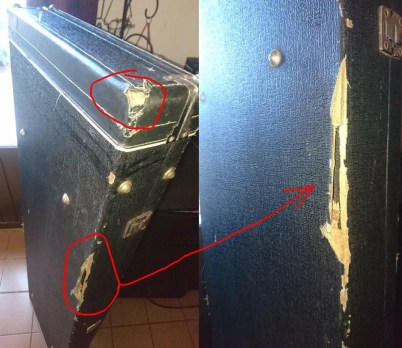
If you are a touring musician that uses flights and your instrument has suffered damage or has been lost by an airline please share your story. I’m trying to get musicians from all over the world to act on this and voice their outrage and concerns. The more the better.
All of our voices could possibly help you get justice. It worked for me. Nothing is required apart from our anger, frustration and voices.
If you have experienced any problems contact
Airlines Smashed Or Lost Instruments group page on facebook.
Interview by Gary Alikivi January 2019.
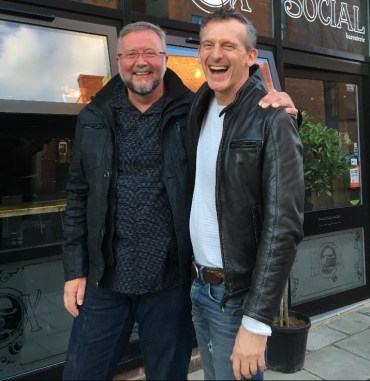
Fred Purser and Jon Deverill
Jon has just released a new album, Square One with former Tygers guitarist Fred Purser…
Square One was recorded in the early 1990s. After the collapse of the Tygers in 1983 guitarist Fred Purser and myself decided to continue our partnership.
I have huge respect for Fred. He’s quite simply the most talented man I’ve met. On the album he wrote, engineered, produced and played all the instruments, except the drums.
We both shared the same vision and were completely on the same page. Our musical tastes are very similar. Fred has his own recording studio, so the facilities were there to make the album. I love the songs.
When was your first experience inside a recording studio ?
I had formed a band called Persian Risk with my good friend Phil Campbell who later joined Motorhead. We went into a small studio in Cardiff and recorded four songs. I loved it. I’ve always enjoyed recording. Creating something is very exciting.
How did you get interested in music and who were your influences ?
I used to sing along to records in my bedroom and watched Top of the Pops religiously. I discovered that I could actually sing the songs so formed a band in school.
My early influences were Alice Cooper, Robert Plant, David Bowie, Peter Gabriel and David Coverdale.
My first band was called Pageant and I formed it with some friends in school. I was fifteen. We played in church halls before progressing to pubs in South Wales.
We took it very seriously and wrote our own songs. At that time I decided I wanted to sing professionally.
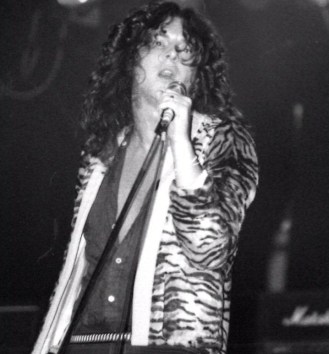
What led you to getting the job with the Tygers ?
I was gigging around South Wales with Persian Risk and saw an add in Melody Maker about the Tygers looking for a new singer. I’d seen the band at Reading Festival earlier that year, 1980. They were great and I very much wanted to join them.
I got in touch and came up to Newcastle for an audition and got the job. I was on cloud nine. My life changed forever. A once in a lifetime chance and I still can’t believe my good fortune.
In the space of a year, I went from playing small pubs in South Wales to Hammersmith Odeon. I was with the Tygers for six years in total. We played in Europe and Japan. To promote The Wreckage album we toured America, plus of course all around the UK.
My first gig with the Tygers was at the legendary Marquee Club in London. Gone now of course. Oh yes, I was living the dream !
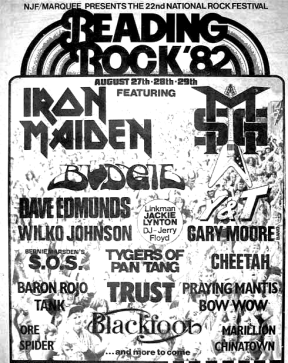
1982 was a good year for the Tygers with a UK tour for new album The Cage, a slot at the Reading Festival in August and appearing on TV show The Tube in December. What are your memories from that time ?
I remember Reading Festival and The Tube very clearly. Reading was amazing. 57,000 people. Our biggest gig ever. We were the last band on stage B and the first to use lights that day. Iron Maiden closed the day on stage A.
The Tube was great too. It was a good gig for us and went out to a big audience. We were on with Twisted Sister who I feel stole the show. They got signed by Atlantic Records after their performance.
Iggy Pop was also on. He was frightening. Really scary. God knows what he was on!


Hellbound – Spellbound Live ’81 album has just been released. What can you remember from those times ?
The live Tygers album was recorded at Nottingham Rock City in 1981. It was my first tour. I loved it. So exciting and I’ll never forget it. High energy and quite literally Crazy Nights!
We were promoting Spellbound which is an album I’m very proud of. I think it’s the best Tygers Of Pan Tang album. I still enjoy listening to it.
After a successful album The Cage, you worked with songwriter Steve Thompson again…..
Even though we released The Wreckage and Burning in the Shade as Tygers records. They were really more like my solo albums.
I loved working with Steve Thompson. He’s a very talented songwriter and we hit it off instantly. We wrote those two albums and I’m proud of them.
Your next move was into acting. How did the change of career come about ?
I’ve always wanted to be an actor. It’s something I’ve done all my life so returning to it made perfect sense. In 1989 I auditioned and got in to The Royal Welsh College Of Music And Drama and spent the next three years training to be an actor. They were three of the best years of my life.
I’ve been working as a professional actor ever since. Never stopped singing and I’ve done a lot of musical theatre. A highlight being Blood Brothers in the West End. I’ll continue doing it.
Music and acting – what do they mean to you ?
Music and acting are my life. They mean everything to me. Being creative and expressing myself is life to me. I have to act to live. I love what I do and continue doing it till the end. They say you’re a born actor. Yes. Totally!
With the Square One album out on the shelves where does it stand with your Tygers work ?
I’m very proud of it. It’s by far my best work. I’m so delighted that it’s finally been released. We never lost faith that one day it would be.
Contact the band https://www.facebook.com/sparechaynge/
Interview by Gary Alikivi January 2019.
Recommended:
Micky McCrystal, Road Works Jan 3rd 2019.
Fred Purser, Square One Dec 30th 2018.
Robb Weir, Rock City Live Dec 19th 2018.
Robb Weir, Doctor Rock Nov 5th 2017.
Richard ‘Rocky’ Laws, Tyger Bay Aug 24th 2017.
Micky McCrystal, Cat Scratch Fever Mar 17th 2017.
Tygers of Pan Tang, Guardian Recording Studio May 3rd 2018.
Ian Penman, Writing on the Wall, Aug 1st 2018.
Steve Thompson, Godfather of New Wave of British Heavy Metal June 27th 2017.
With the blog hitting over 50,000 views and 199 posts so far, a milestone 200th post comes from a piece in local newspaper The Shields Gazette. Journalist Peter French writes on his page about the post of 14th January 2019 where I featured the music scene in South Shields during the 90s.
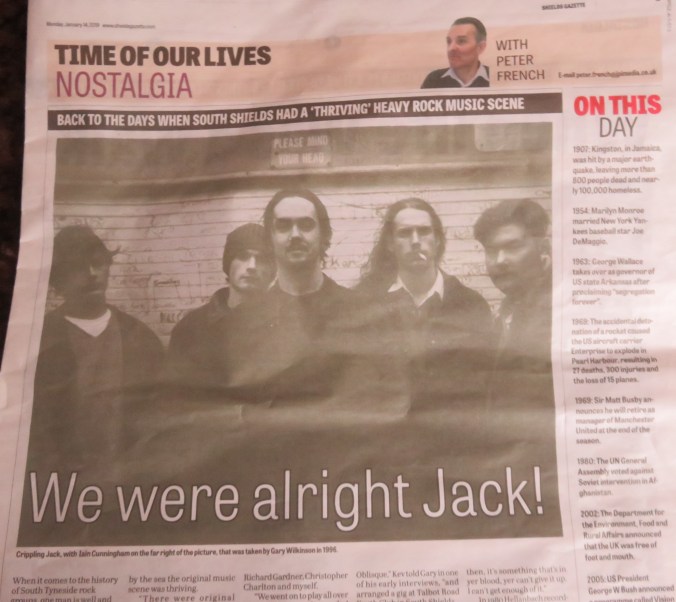
The Shields Gazette 14th January 2019.
Link to full piece:……https://www.shieldsgazette.com/lifestyle/nostalgia/when-south-shields-had-a-thriving-rock-scene-1-9535098
Thanks to all readers of the blog so far I’m looking forward to adding more interviews including former Tygers of Pan Tang vocalist Jon Deverill, Burnley blues/rock band Cloverhill and a feature on the issue of instruments damaged on airlines with UK Subs guitarist Steve Straughan.
Gary Alikivi January 2019.


The title reflects the original music scene in South Shields during the 1990s. The town had countless numbers of venues booking bands who played their own music.
But it isn’t the case today. Looking through some photographs I took then, I wondered what the bands thought of those times ?
Iain Cunningham, (Cripplin’ Jack) The 90s was a great time for music. In Sunny South Shields by the Sea the original music scene was thriving. There were original bands with lots of venues willing to give them a stage to hone their craft.
Whether it be a Sunday night in the Ferry Tavern, Wednesday night was spent in Porters and The Vic was a Monday night downstairs or Saturday night upstairs. There was always somewhere to watch original music.


It felt very much like a community and I’m surprised none of the bands actually cracked it and broke through to the mainstream. It was a great scene to be part of.
The nights had great crowds, a cracking atmosphere and cheap beer promotions, which usually lead to hangovers and regret.
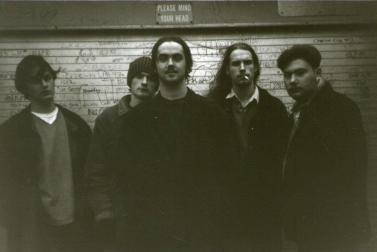
Cripplin’ Jack in 1996. Iain Cunningham on the right.
Crippling Jack were formed in 1995 by Ian Maxwell, Dean Walsh, who was later replaced by Paul Westgate, Richard Gardner, Christopher Charlton and myself.
We went on to play all over the North East and recorded our demo John Woo E.Q. in the Underfoot studios with Dave and Pete Brewis, who themselves, are enjoying a great career in music with their band Field Music.
Davey Mac was a supporter of the music scene. His rehearsal rooms were legendary and, if they could speak, would tell some stories. I think we still owe him a small fortune as we always ended the rehearsal shouting back up the stairs to him ‘We’ll pay you double next week!’
Actually Crippling Jack reformed in 2009 and went on to play more gigs around the town releasing two more EPs. After nine years apart, vocalist Ian Maxwell summed up the bands feelings as he stepped up to the mic and declared… ‘It’s good to be back’.
Iain Robertson, (January Blue) This band had many incarnations, and it all started with me and vocalist Woody who were mainstays throughout January Blue and later New Rising.
We first played a gig together in April ’92 at Cleadon Village Hall with another band called Agadoo Factory. This gig featured the first song Woody ever wrote called Die Forever !
We wanted to keep going and little did we know that we’d be still playing together eight years later, frequently visiting London having gained a record deal with London records.
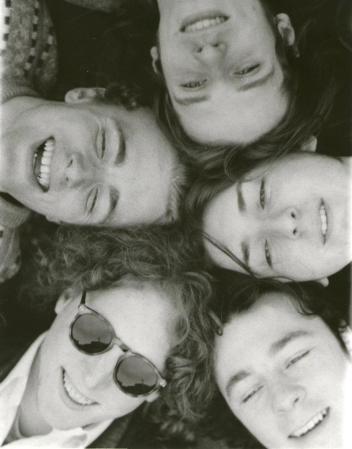
January Blue in 1994. Iain Robertson at the top.
We’d heard Pete Edmonds the manager of Porters bar in South Shields, would pay £300 a gig if you managed to pack the place out. So we hit every bin in King Street with a flyer and our piece de resistance was at 6.30am hanging a bed sheet on both sides of Westoe Bridges to catch the rush hour traffic coming in and going out of town.
We got an ear full (and rightly so) for plastering one flyer on the arse of the war hero Kirkpatricks donkey statue in King street, which in hindsight was disrespectful but hell – we had a gig to promote.
Needless to say, Porters was full, we got our £300 quid and Pete Edmonds was bouncing around and grinning like a Cheshire Cat. He booked us again and we were definitely in a good bargaining position for the next gig’.


Newts Newton, (Cloud 10) On reflection, I didn’t really enjoy the ’90s in general for many reasons but musically, I detested all that ‘mad for it’ ‘avin it’ laddish bollocks.
It seemed like every new band had curtain haircuts, walked like chimps and stood onstage like tins of milk, wearing tracker tops zipped up to their noses, all while strumming mindlessly with faces like a smacked arse. Trying to be ‘edgy’. Aye right, fuck off man.
Meanwhile, the band I was in at the time, Cloud 10, were writing kitchen sink drama style songs that moaned about all and sundry, while we marched about in overcoats and quiffs thinking we were the fucking Clash, glowering at everyone (laughs).

Cloud 10 in 1996. Newts on the right.
Locally, plenty bands were springing up and yeah, we in Cloud 10 pretty much sneered at them all. Not that we had much to be smug about mind, we were arrogant and nothing special really.
Looking back, being brutally honest, it was a waste of time as our band were better at talking about things, instead of actually getting up and fucking doing them.
Although one night, two of us did go out and do some promotion work with two roller brushes and 10 litres of minty buff emulsion paint. But ultimately, it was all pointless.
Interviews by Gary Alikivi December 2018.
Since we last spoke in March 2017 Micky McCrystal has in his words ‘been a bit busy.’ Guitarist for Tygers of Pan Tang is Micky’s main gig but he also teaches guitar here in the North East and has recently been touring with Marco Mendoza.
This past year has been crazy because I’ve done a lot of touring with Marco Mendoza (ex Blue Murder/Ted Nugent/Whitesnake). We played nearly 100 shows together within 6 months.
A lot of the shows were in countries like Hungary, Austria, Czech Republic, Slovakia, Romania as well as a lot of shows in Germany and the UK. With the Tygers we played around 30 to 40 shows in 2018.
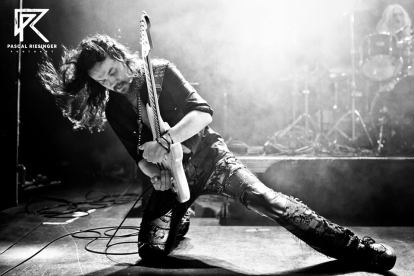
Our last shows of the year were in Spain, Japan and the UK. Japan was amazing, the Tygers fans are super passionate out there similar to South America where they’ll figure out which hotel you’re staying in so they can get a photo and get albums signed etc.
They’re super polite and kind and would bring gifts for us, however as soon as we hit the stage they lose their minds and sing every word and guitar lick (laughs).
Our tour schedule was surprisingly quite relaxed for Japan. We flew out there and had a day off. The gig was the next day headlining our night at 7pm. We had another day off then flew home.
I’m hoping when the next album is out, we’ll go back and play some other cities too.
How did the Tokyo gig come about ?
I’m not 100% sure but I know we received a message from our booking agent who’d been talking with a promoter of a festival out there. We got an email saying ’Do you want to play in Tokyo’. Simple as that really.
To be honest I leave that stuff down to our agent I just get told where and when to turn up with my passport and guitar (laughs).
Can it get tiring long journeys on the road ?
Yeah, often depending on the tour schedule but there’s little distractions now which I guess people didn’t have years ago, you’ve got everything in your phone now, camera’s, music, internet etc. I tend to find I’ll listen to music, read or work on things music related to try and occupy the time.
Believe it or not the Tygers Spain tour was more tiring than Japan. We had shows every day with eight-hour drives and the stage times at the earliest are midnight so by the time you’ve signed merch and talked to the fans your lucky if your back at the hotel by 3am then hit the road at 8am and repeat. (laughs)
Don’t get me wrong though I love being on the road and the fans were amazing in Spain.
How did working with Marco Mendoza come about ?
I was at the 2017 NAMM show out in L.A. demoing for various companies. We met out there and found we had a few mutual friends. We stayed in touch and later that year we did a six week European tour.
This year we’ve toured Europe in February, March then May and June. They’re intense tours, very much show after show back to back which I love and to be honest I prefer that.
Sometimes having a lot of days off gives you time to think and I end up missing my fiancé and family. Depending on what country you’re in you can go sightseeing but others can be dangerous… certain areas of South America you don’t wander about without knowing where you are, or you can get yourself in some serious trouble. (laughs)
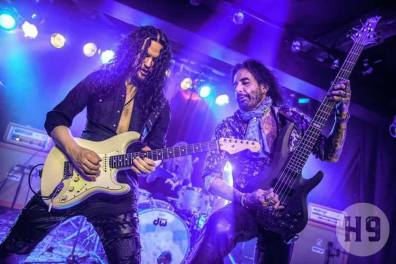
Playing live with Marco we would play everything from rock and blues through to fusion and some latin stuff too. He’s big on improvisation and would give us cues on stage ‘go to the bridge’ ‘chorus’ or ‘Micky solo’ stuff like that.
Structure of song’s would change every night, so you had to be on it, but it keeps you on your toes and it’s fresh and fun. I loved it and have learnt a lot from Marco, he’s a mega talented guy.
Is there a new Tygers album soon ?
We’ve got an album’s worth of material, but we just need to fine tune it. I’d say it’s heavier than the last album. I feel like the last album was quite diverse, but I spoke to the guys about us focusing on more of a hard rock album for the next one, I felt songs like ‘Only the Brave’ on the last album were such a success with the fans that we should focus on that hard rock vibe.
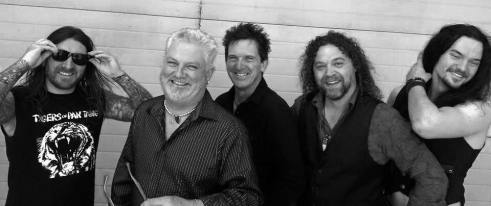
In the studio do you work with a producer ?
On the last album we had Mark Broughton producing the album with us. He works with Andy Taylor (ex Duran Duran/Power Station). He gave us input and had some great ideas. We also do that with each other within the band.
One of us might say ‘maybe that’s not working, try this,’ and we’ll work together to try and get the best possible result. For myself I find that really helpful and Craig (Tygers drummer) has a great ear for melodies, so I’ll tend to run a lot of ideas particularly my solo ideas past him first.
Working like that do you come across any happy accidents ?
The main riff in Glad Rags from the last album was me literally messing about in a rehearsal and I played it as a joke. The guys said ‘What’s that?? It’s good’.
Sometimes you’re not the best judge of your own work and you need someone to say that’s the take or that’s the riff or else I would sit in the studio until I’m a skeleton (laughs).
For the Tygers, I try and write solos like a composition within a composition. In my mind I always think of guys like Randy Rhoads whose solos are like a song within a song.
What’s in the diary for 2019 ?
There’s an album’s worth of Tyger songs nearly ready and it’ll probably be the same team that worked on the last album. Søren Andersen (Glenn Hughes) mixing and Harry Hess (Harem Scarem) mastering.
Once the album is released we’ll be following it up with a tour. I’m also looking to release a few more guitar lesson products through Jam Track Central in 2019.
For Micky’s latest lesson package releases go to…http://www.jtcguitar.com/store/artist/micky-crystal/
and for the latest Tygers of Pan Tang news go to…http://www.tygersofpantang.com/official/
Interview by Gary Alikivi December 2018.
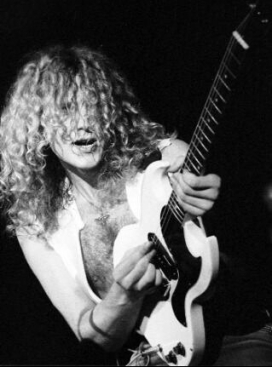
pic by Rik Walton
Fred has just released new album Square One with former Tygers vocalist Jon Deverill.
Fred was guitarist in North East bands Penetration and Tygers of Pan Tang, and I was a long haired 16 year old when I saw the Tygers at a packed out Newcastle Mayfair in 1982….
I remember with affection the gig at The Mayfair. The likes of AC/DC had played there and in the same dressing rooms, same stage, here we were! It was fantastic and with a local audience that was icing on the cake really.
The Cage tour was in support of the fourth album from The Tygers, and it took them in a different direction….
I was involved in writing a few songs from that album. After a lot of touring and writing there was a lot of pressure on the band and with the new writing going towards an AOR, polished kind of sound.
Our producer Pete Collins was trying new sounds to bring into rock that hadn’t been done before like Simmons drums.
It was strange hearing these synthetic and polished sounds in the recordings. Def Leppard used them all over their next albums. We could have paralleled their success if we didn’t have problems with our record label.
We were riding high, the atmosphere in the band was great we were getting on really well but the guy who signed the Tygers was moved up a notch in the record company so he had other priorities.
We didn’t get the commitment that we were hoping for from MCA, and as Def Leppard and Iron Maiden were getting huge support we weren’t.
We had released the cover Love Potion No.9 it had done really well and someone in the record company thought it would be a good idea to adopt the same approach for the next songs.
‘Play Motown covers with a rock sound’. But we didn’t really want to do that, so we entered into an impasse situation with MCA.
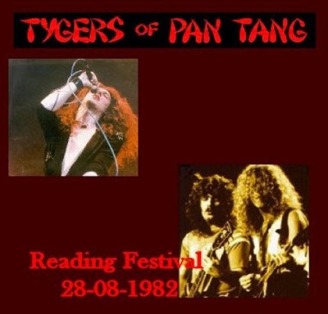
I had come up with some other material with Jon’s (Deverill) voice in mind and they liked it but there was still this situation between us, and it kind of all just slowly fell apart. We had a heavy weight around our necks.
Things were slowly getting worse. They were ok with the demos but MCA knew they would have a huge bill for recording, so it was getting harder and harder to get this thing out.
Subsequently I got more involved with the studio and started doing session work. Jon took the Tygers on further with songwriter Steve Thomson, and he did a few more albums after that. We’ve always stayed friends over the years.
He lives in London and I’m here in the North East so if he was on tour or I was down there we’d met up for a drink and a curry. Phone calls back and forth you know. But the project I was writing I always felt it had something because it had such positive feedback.
What did Jon Deverill do after the Tygers ?
‘He’d always liked stage work, so he went to an acting school in Wales, learned his craft and qualified from there. He’s forged a career out of it because acting is a really difficult thing to get into. Theatre is his preferred thing.


The album that you and Jon have just released ‘Square One’ was all of that wrote at the time of leaving the Tygers ?
Not all of it, I had about four songs and since then at various times have developed them and added more through writing sessions and recorded the vocals when Jon was available.
Life got in the way over the years so it was a case of attending to it when I could. Engineering and recording work took over and performer, producer, had to take second place.
To revisit it was a nightmare because technology has moved on. From analogue, tape alignment, just digging out those tapes presented technical problems.
Using pro-tools had its advantages seeing the problems right there, and not using razor blades to cut the tape anymore (laughs).
What was the feeling first time listening back to those songs, was it a pleasant surprise ?
With anything you do you would do it different, some of them were from 30 years ago. You always reappraise things you know ‘Could have had more of this or less of that’.
I probably over scrutinised some of it and been a bit finickity about it, but I enjoyed working on them.
Having an external producer is a good idea because they can hear things in it which you might not. They would say yes that’s the one with its happy accidents in it rather than the straight jacketed version I was going to use.
How did you get into studio work ?
I was just fascinated with the whole process. When I was in Penetration we would go in a studio and it was wow, really impressed by it, and I just asked loads of questions.
For session work I was working at studios in London like Snakeranch, Marquee, Phonogram I would ask the guys what’s this, how does this work and they would tell me, encourage me and said I had good ears. They’d say ‘Why not consider doing this, because you can’.
This was to their advantage because I would come down to do some backing vocals, keyboards or guitars for a mainstream act and I could also engineer it. They could then get on the phone for that next production job for Roxy Music or somebody (laughs).
What type of session work did you do ?
People like Elaine Page, Tracey Ullman, even Alvin Stardust are the one’s I remember that had mainstream success. I had done some stuff with Peter Collins (Tygers producer) and he was working with Gary Moore.
When it came to the time when your name was to be added to credit lists, I just wanted to add my name, but Peter said I wasn’t sure you would want that because Gary Moore doesn’t like to be credited, he thinks it’s uncool cos he’s a rock guy. I thought about it but went ahead with my name, I didn’t think it wasn’t cool (laughs).
How did you get interested in music ?
I was born in an industrial town and went to school where some of the teachers thought they were doing you a favour by knocking any type of wonder out of you.
Exactly opposite to the American ethos of you go for your dream. I ended up getting a place in Newcastle University to study architecture. I took a year out of that to work on a trading estate to get the money to buy a guitar.
I got out there and played with local bands. I grew up listening to Bowie, Mick Ronson, The Who and when the punk thing came along I loved the energy of it. I also wanted to improve on my technical side of playing guitar.
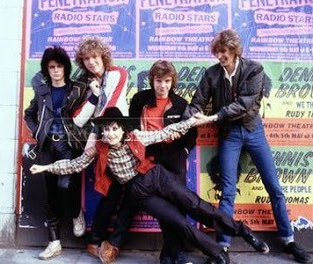
How did the Penetration job come about ?
Penetration came along after they were already signed to Virgin for a couple of singles and were looking to do an album deal. The record company wanted the band to have another guitarist/writer involved and as I’d already played with Gary Smallman the drummer, he recommended me to the band.
When I met them, they had a real chemistry, the atmosphere was good, so I gave it a go and we played The Marquee. It was really exciting, loved it and Virgin signed us that night on an album deal.
The architecture thing was still there and the sensible voices were saying architecture means a steady job but the music biz ooh no (laughs). But I was young and didn’t want to arrive at 45 look back and say what if you know.
I joined Penetration in ’78 and was with them until the end of ’79.
Do any moments stand out when you were in Penetration ?
Yes we were on tour in the USA and I turned 21 in Boston. It was a blast. Great fun.
We were out there on the same tour that The Police had done, they had done the circuit twice and they broke. Squeeze had done it, they broke. But after the first circuit of that tour we were over worked, burnt out.
Virgin were a great label but turn over for albums was quicker in those days and they wanted another one quickly. Just too much. Sadly we split.
In hindsight if we had just had a holiday maybe taken four weeks off and come back refreshed, that would of worked.
When Penetration toured the States you weren’t travelling in luxury then….
(laughs) No the perception is that it can be a glittering world, we didn’t complain about it then because it was a great opportunity. But looking back it was very tiring travelling hundreds of miles every day sitting on your backside for 8-9 hours in the back of a van.
When I was young I used to read the Sounds and read the back of albums things like that and think it would be very glamourous. But the reality is it can be quite mundane.
When I joined Penetration we were getting £25 a week. Before we played The Marquee we got a telegram from Ian Drury to wish us luck. But he was only on £25 a week when Hit Me with Your Rhythm Stick was number one in the charts!
Obviously that money would filter in later on, but the record company put a lot of money into the band and until you reach that break even line your just on the recoupment phase.
They want their loan repaid before you see any money. So, they would pay you per diems of say £10 per day so you can get food and essentials.
There would be bands in great recording studios impressed by it all, rightly so, but in the background is the ching, ching sound of the money register. They are accruing a debt to the record company, and they want it back.
Did you have management at the time ?
With Penetration we had Rory Gallagher and Status Quo management. We had a young energetic manager called John Arnisson who went on to manage Marillion and I think now he manages Billy Ocean.
The Tygers had Graham Thomson as tour manager and day to day and other more important stuff was handled by Tom Noble, still a friend of mine. He also manages Jon and I for the Square One project.
Have you met people who you looked up to as musical heroes ?
Yes in Penetration when we were touring USA the tour manager was a guy called Stan Tippins and he tour managed Mott the Hoople.
When we played New York Ian Hunter came along to see the band. I had problems with tuning on my Gibson SG. All night it had been drifting out of tune and he came backstage.
Well here he was, I grew up listening to All the Young Dudes and he was such a nice guy… ‘I know how you can fix that ‘ he said as he worked on my guitar with a graphite pencil. I was gobsmacked. There it was, Ian Hunter sorted out my G string tuning on my Gibson SG (laughs).
Then you had Mick Ralphs hanging around, we were backstage in the Whiskey in L.A. with Joan Jett. Unfortunately never met Mick Ronson who was the guy who got me wanting to play the guitar. We also did a French tour supporting Rory Gallagher which was a real education.
When I was in the Tygers I met all the Maiden people, Lemmy, all the guys in the rock bands that were around those days. Your peers really.
Not a hero of mine but seemed a canny lad when I met him was Roy Wood. I was in the lift of Hammer House and he got in. He had all the hair and the beard (laughs) Just a short guy with a Brummy accent. This was ‘78 after the Christmas song and all that, this felt like another world.
Any plans on taking Square One out live ?
If this album does anything really exceptional, I’d love that to happen but I’m realistic enough in today’s climate that I would be happy enough for people just to hear it.
Should it get enough interest to make it financially viable it might be there as a possibility. Thing is you want to put out your best and people deserve to hear it fully and at the best quality.
Purser/Deverill album ‘Square One’ with Jeff Armstrong (drums) Jon Deverill (vocals) and Fred Purser (keyboards/guitars) out now on Mighty Music.
Contact the band at
https://www.facebook.com/sparechaynge/
Interview by Gary Alikivi December 2018.

Since releasing their last album in 2016 the Tygers have had a successful two years equalling or maybe bettering the NWOBHM days back in the ’80s.
2018 has seen them playing gigs around the UK and Europe with Kiss, Ozzy and the Dead Daisies plus a recent headline show in Japan. Can they add more to the well oiled machine?
With a new live album release ‘Hellbound-Spellbound ‘81’ from the line up of Jon Deverill (vocals), John Sykes (guitar), Brian Dick (drums), Rocky (bass) and Robb Weir (guitar) I asked Robb was this a recording of that line up at its peak?
Yes absolutely. John Sykes played on the Wildcat tour in September ’80, but not on the Wildcat album and Jon Deverill joined us just before Christmas 1980.
We were writing for the next album and with the ‘new blood’ in the line-up the sound changed a little bit because those two great guys brought a different edge to the Tygers, more melodic, I think.
Wildcat had a heavier feel to it and a bit of a punky element to it as well. I played it in its entirety a while ago and didn’t realise how much punk music had influenced me.
The opening track on this live album, ‘Take It’ was written by John Sykes and me. When John first joined the Tygers he came round to my house to learn the songs for the then, upcoming Wildcat tour.
During these sessions John said I’ve got an idea for a new song. He played me the front end, (opening) of ‘Take It’ I liked it, added in something I had, played it together and added a chorus and ‘Take It’ was born.
Unfortunately, it was the only song that John and I wrote together. I was used to writing by myself, John and Jon Deverill lived in the same flat, so they worked on songs together.
As for both Spellbound and Crazy Nights the song writing guitar riff ideas were 50/50 between John and me. Then we would put them in the pot and they become everybody’s adding drum parts and bass.

What were the nuts and bolts of making this live album ?
We were on the UK part of the Spellbound tour in 1981, it was the second show of the tour at the Nottingham Rock City venue. Normally you would record a live performance on the last day of a major tour when you’ve had 30 odd dates to have a bit of a practice!
But the Tygers never do anything easy, always back to front and upside down, we’re at the front of the queue for that (laughs).
Our record company at the time MCA hired the Rolling Stones mobile recording unit. Which was quite revolutionary in those days, it was an articulated lorry with an amazing recording studio inside of it and was owned by The Rolling Stones.
It was a business venture for them, and they hired it for location recording.
This mobile studio was made very famous in the seventies when it went to Montreux to record Deep Purple and ‘Smoke on the Water!’ It was state of the art at the time.
It parked outside Nottingham Rock City running all the recording lines inside so effectively all your equipment was double mic’d. One mic for the live sound in the hall, and one mic that ran back out to the truck for recording purposes.
Who was engineer on the recording?
Chris Tsangarides who had produced both the Wildcat and Spellbound albums had come out on the road with us to do our front of house sound. However, on this special night he couldn’t be in two places at once so he did our sound check for us and set the sound up.
The guy who came with the huge sound system that we took on the road with us did front of house sound mix that night.
In those days you took your show on the road with you. It wasn’t like in Academy’s these days where everything like lights and sound system are already in house, and all you need is your backline.
In those days when you went into a hall it was empty. So, you had to put your sound system and lighting rig in.
Consequently, touring then was a lot more expensive. When you did a big tour with a big production, you almost lost money, but you did it to promote your album hoping next day people would go to the record shop and buy it. That’s where you would recoup your money for the tour.
On the day of recording Chris Tsangarides set the sound up and then went into the mobile where he did the sound check again so he could set the levels and tones on the recording desk. When we were playing live Chris did what you call an ‘on the fly’ mix as well.
What was the set up as far as sound equipment and crew for the Spellbound tour?
On the Spellbound tour we had two 40-foot articulated tractor pulled trailers, and a night liner bus for the crew. We had a 16 man crew working for us.
It was quite a big do as they say and in ’82 when we did The Cage tour that was an even bigger production, both productions cost a lot of money.
Of course, you hope to get bums on seats to recoup a bit of that back. Support bands would pay to come out on the road with you because that’s the way it was done. That money all went towards the headline bands costs.
As far as I remember when we went out, we took the Malcolm Hill rig out which was famed for AC/DC using it. I’m pretty sure it was a 35,000-watt rig, which was a lot of noise coming out the front of the system at you!
Then on stage we had about 12,000 watts of monitors. I used to have two 1,000-watt wedges in front of me and they were on full tilt. We used to play loud, really loud (laughs).
The live recording was at Nottingham Rock City. Was that a memorable day in the Tygers history?
Actually, there was a prequel to this show. We were staying at The Holiday Inn in Nottingham and we were all absolutely laden with flu apart from John Sykes. We were so bad our Tour Manager called for medical advice.
A doctor came out and said we shouldn’t be playing, particularly Brian our drummer because he was an asthmatic. He had an array of inhalers which he used to take in-between smoking his Embassy regals (laughs).
The doctor actually wrote us out a sick note to excuse us from playing, I don’t know who we were going to show it to! Maybe Tom our manager has still the sick note? (Laughs).
But there was no way we weren’t playing, the gig was sold out and we were recording it.
After the gig did you hear the recording played back?
At the end of the show John Sykes, who was as bubbly as ever, went to see Chris in the Rolling Stones recording mobile, they had a discussion and John came back and said Chris doesn’t think it’s very good.
I can’t remember whether he had said we had made some mistakes, maybe not played very well, or something had gone wrong in the recording process, I honestly can’t remember.
Nothing more was said and I guess the record company (MCA) who paid for the whole deal must have been gutted. Again there wasn’t an inquisition about it, it was just left.
It was all recorded on 2-inch Ampex tape and our manager Tom Noble took them away and they lived under a bed in his spare bedroom for years. It was only Chris and John who had heard anything from the tapes. Brian, Rocky, Jon Deverill and myself hadn’t heard anything.
The life of the band moved on until 2000 when I said to Tom the Tygers manager, ‘you know those live tapes from ‘81 should we have a listen to them?’ He said, ‘yes, they’re under the bed in the spare room.’
So, we asked Fred Purser who replaced John Sykes in 1982 and recorded The Cage album, then toured with the Tygers.
When Fred left the band, he went into the production side of the music business. Fred now has a wonderful studio called Trinity Heights in Newcastle.
He agreed to do it, but we had to hire a machine to play the tapes on because they were outdated. There was nothing in the North East so we had to ring down to London and hire a 24 track Ampex tape playing machine.
Fred took delivery and transferred the tapes to digital format but because of the age of them we were told we probably would only get one chance to copy them as the Ampex tape could disintegrate! Luckily we did it.
What did the recording sound like?
Fantastic, Tom and I couldn’t understand why the tapes hadn’t been used? The only thing that was wrong was because of time, the first four tracks on my guitar had ‘fallen off’ the tape.
So, I sourced the same pick up I had on my Gibson Explorer at the time, put it on a suitable guitar and went in the studio and recorded my guitar part’s again for the first four tracks.
That is the only thing that has ever been touched so this is a complete live album with no overdubs, unlike a lot of live albums back in the day!
It has now come out years later that on some live albums back then maybe only a snare drum was live, and the band went back into the studio to record most of it again– a bit naughty, but I understand band’s want their best work recorded.
But if you can’t play live, should you really be in the business? I’m very proud that ours IS live.
Robb and Soren Anderson.
Why the re-release now? Well Fred mixed it, and it came out in 2000 on general release. Three years ago, when we signed with Target Records the C.E.O Michael Anderson, asked whether we would be interested in putting out a remixed version by Soren Anderson, who mixed our current album.
So, it’s been on the back burner for a while. It just so happened the timing was perfect because Soren started a mix on the album and two weeks later, he appeared in Newcastle playing with former Deep Purple bass player, Glenn Hughes.
I went to see them at the Academy here in Newcastle and met Soren, he said he had a day off the next day in Newcastle. Michael McCrystal (Tygers guitarist) managed to get us some studio time at Blast Studios, through his academy of music connections. This is where we recorded all the backing tracks for our current album.
So we went into Blast, he put the album up and listened to some of the mixes that Soren had done and I suggested some things.
All that’s happened is the tones of the instruments have been sharpened up, levels have been changed, we found backing vocals which were too low in the original mix, it’s come out really well, it’s a huge sounding live album now to be fair.
The record company are bringing it out on various formats, CD, vinyl and a box set including a signed tour poster and a ticket to Nordic Noise Festival next year in Copenhagen. It’s a great package. There’s also a tour pass from 1981.
‘Hellbound – Spellbound 81’ is available 21st December 2018 via the official Target Records website and in the shops 25th January 2019.
Interview by Gary Alikivi December 2018.
For more Tyneside stories why not subscribe to the ALIKIVI You Tube channel.

In 2019 The Toy Dolls will celebrate 40 years of being in the business but back in 82 The Dolls played in the foyer of live British tv music show The Tube, broadcast from Tyne Tees Studio in Newcastle.
While ripping through ‘She Goes to Finos’ behind the band was a huge yellow backdrop and bank of tv screens.
Presenter Muriel Gray said “That incredibly energetic and slightly mad bunch are The Toy Dolls. A Sunderland based band. They were signed with EMI but unfortunately EMI let the contract lapse after only 12 month and one single. But happily a two man Newcastle based recording company called Volume snatched them back from impending obscurity. Well hope they are favouring(?) any damage done in the foyer”.
When did the music bug hit you Olga ?
‘I got into playing music after watching Suzi Quatro on Top of the Pops. I knew from that moment what I was gonna do! Be a bass player.
I saved up for a bass guitar for a year by doing a paper round, but when I went to buy it, it had gone up by £1! So I just bought a guitar instead’.
Early influences for Olga were Dr Feelgood, Status Quo, The Pirates…
’Also listened to Slade, Suzi Quatro, The Sweet, Eddie & the Hot Rods and most of the early Punk bands, The Jam/Clash/Pistols’.
Since ’79 many drummers have been and gone, plus a few bassists, but the line up for The Toy Dolls in 2018 are Olga: Guitar & Lead Vocals. Tommy Goober: Bass & Vocals. The Amazing Mr Duncan: Drums & Vocals.
Olga and Duncan both live in London and Tommy lives in Germany.


Back in Sunderland during the late 70s Olga played in local band ‘Straw Dogs’ then formed The Toy Dolls…
‘Started in October 1979 and for a long time we just played locally around the North East UK. Then the Angelic Upstarts gave us a support slot on their UK tour, to whom we are eternally grateful.
In 1985 we met our manager, Dave (RIP). He got us gigs worldwide for the next 30+ years’.
When you were based in the North East where did the band record ?
‘At first it was Guardian Studios in Pity Me, Durham. That was where we always went from the beginning and for many years to follow. I think it was about £40 a day then, which was expensive for the early ’80s.
We recorded singles mainly, until 1983, when we recorded our first album Dig That Groove Baby’.


At a time when Eurythmics, George Michael and Spandau Ballet were regularly hitting top ten and the Band Aid single was number 1, The Dolls crashed the UK singles chart in December ’84 with a cover of ‘Nellie the Elephant’. It entered the chart at 16 and reached number 4.
They also filmed a music video for one of their songs at Penshaw Monument in their hometown of Sunderland. The band also recorded some TV appearances…
‘Yep quite a few. The usual pop shows in the UK like Razzmatazz, Top of the Pops and quite a few TV shows in Germany, Holland and Switzerland’.
Have you any funny stories from playing gigs ?
‘Ha, too many to mention. One story I will never forget is the first time we played in Sao Paulo, Brazil. A skinhead managed to climb over 4,000 people, through the security, got on stage and smashed me in the face, knocking my tooth out. And he was a fan can you believe!
He even came backstage after the gig to say how much he loved the show. No apology though!’
After being involved in music for over 40 years what does music mean to you ?
‘What else am I gonna do ! Busy writing a new Toy Dolls album at the moment, and almost finished! “Music was my first love and it will be my last”…. Ha, pass me the sick bucket, though its true!’

Along with writing a new album, the rest of the year has a couple of live European dates in December including a sold out show in Geneva.
With a feature on the bands website ‘Ask Olga’ where fans ask questions about touring, records or Olga’s chewing gum – he’ll always be busy. Go on ask him!
http://www.thetoydolls.com/index.html
Interview by Gary Alikivi November 2018.
For more Tyneside stories why not subscribe to the ALIKIVI You Tube channel.
 ALIKIVI : NORTH EAST UK MUSIC & CULTURE