SUNDERLAND MUSIC with Ray Dobson & Trevor Thorne

Ray Dobson & Trevor Thorne with their book ‘Music in Sunderland’. (Alikivi collection May 2022)

“Don Airey was in my year at Bede Grammar school and each year there was a concert with the highlight being a band playing pop songs. I remember being impressed with Don playing the school organ on ‘House of the Rising Sun’.

Little did we know he would go on to play with Deep Purple, Rainbow, Whitesnake, and Black Sabbath while also playing on over 300 albums” said Trevor.

An excerpt taken from a book produced in Sunderland by retired teacher Ray Dobson and semi-retired accountant Trevor Thorne. Ray also brought his background as a local music photographer while Trevor has written several local history books.

They hit on a method of working with one taking the lead on a subject and the other chipping in with their own knowledge of different genres from skiffle to rock to punk and bringing it up to date with Sunderland bands Field Music, The Futureheads and The Lake Poets.

Geoff Docherty with his book ‘A Promoters Tale’.

The book also highlights the work of Geoff Docherty

“Geoff’s forthright and honest manner endeared him to his audiences and the performers. He is today, remembered for his huge contribution to the musical culture of the North East”.

Ray added “Geoff is primarily known as the most successful rock music promoter in the North East. He was determined to bring quality live music to the area and his first venue was the Bay Hotel in Sunderland where he began by booking Family for the huge fee of £150”.

”The gig was a success and was followed the next week by an unknown band called Free – Geoff remembers people arriving under the illusion that they wouldn’t have to pay an entry fee”.
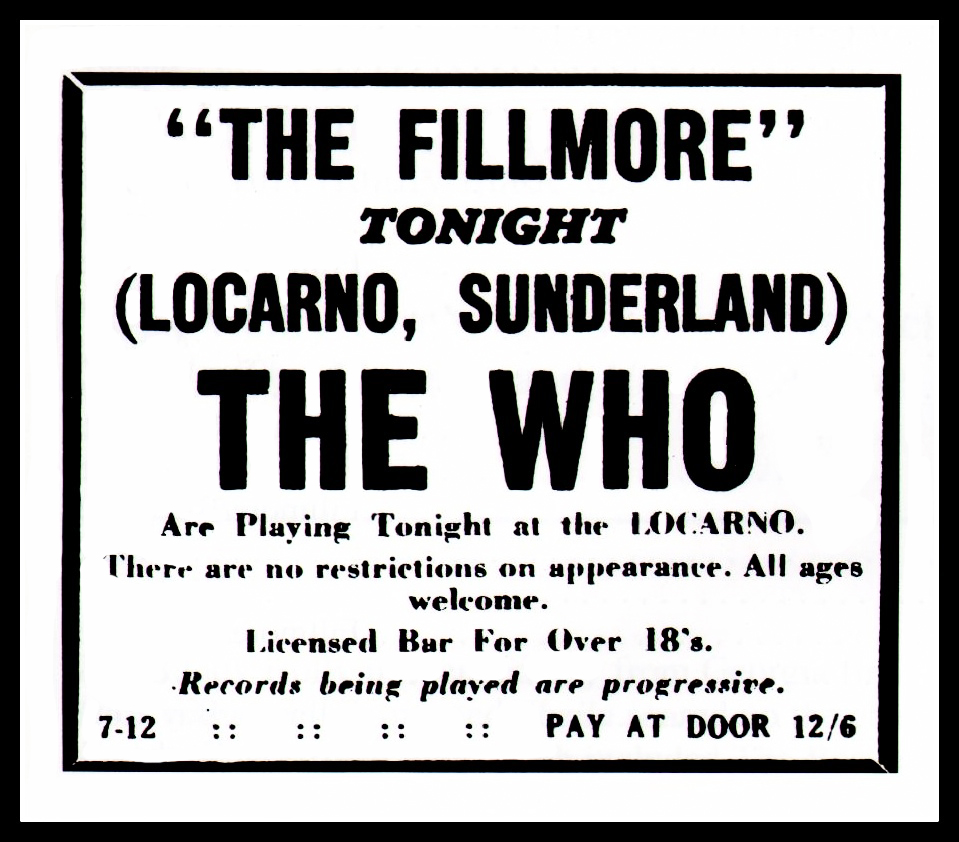
The Who at the Locarno 1969.

The Bay continued to attract huge stars including Pink Floyd, Tyrannosaurus Rex and The Who. In 1969 Docherty moved to a larger venue and a who’s who of legendary rock bands such as Mott the Hoople, The Kinks and Bowie followed.

“Perhaps Geoff’s greatest achievement was to bring one of the world’s top bands to town. He used his powers of persuasion to talk the rather daunting Peter Grant (manager) around to allow Led Zeppelin to perform at the venue, but on the eve of the event he was told the band would not be coming”.

“This only served to increase his determination and after numerous attempts to impress on Grant that he owed him a gig, it was eventually agreed he could have Zeppelin – twice”.

“Geoff also had a secondary career in band management. The best known of which was Beckett which included Terry Slesser – who later formed Back Street Crawler along with Paul Kossoff. Kossoff even lived with Geoff, under his care, while recovering from addiction”.

“Beckett performed on the Old Grey Whistle Test and had an acclaimed, though not commercially successful album, to their name. Unfortunately, they parted ways on the eve of an American tour and the chance of stardom faded away”.

Trevor added “One of the most intriguing bands we came across was Juice. From posters and online information, they seemed to be everywhere.

The band supported Pink Floyd, Free, Blondie, Deep Purple, The Faces, Terry Reid, and Black Sabbath as well as many others. We eventually tracked down the drummer Kelly Davis, who had a fund of tales to tell”.

“It seems they were the go-to support band during the 1970s. Kelly was particularly complimentary about Ian Paice, the Deep Purple sticksman.

While they were waiting for their gig to start, Paice went through the drumming routine for ‘Black Night’ with Kelly, taking up an hour and a half of his time to pass on tips on that and other songs. In 2011 Juice got together again and still record songs”.

Kiss album ‘Rock & Roll Over’ released in 1976.

Ray recalls a story about American born songwriter & musician Sean Delaney who is often referred to as ‘The Fifth member of rock band Kiss’ and “had worked with the likes of John Lennon, Cher, Clive Davis and many others. He played a key part in designing the Kiss stage make-up, choreography and pyrotechnics”.

“Sean was raised in Utah but moved to New York where he became involved in the music scene. An accomplished musician in his own right, Sean met producer Bill Aucoin in Max’s Kansas City, it was here the two spotted a new band and, took them under their wing.

Under their guidance the band were to become one of the most famous rock bands in the world – Kiss”.

“Several successful years later, having personally produced and co-written songs for both the band and their solo recordings, Sean moved to Arizona.

There he was impressed by an English/American band named Smith and Jackson. When the English contingent returned to the UK, Sean resolved to follow them and manage the band”.

“Much to everyone’s amazement, he arrived in Sunderland a few weeks later where he lived with singer Paul Jackson and his family. He became a great friend to many locals and would often stay with my wife Sue and I.

Sean fell in love with the local pubs and became a popular figure on the local music scene, where his outrageous eccentricity endeared him to everyone”.

“While in town, Sean produced an excellent album for Smith and Jackson to which he contributed two of his songs. The album was released on RGF Records and was intended for the ears of Gene Simmons (Kiss)”.

“I remember on Christmas Day 2002, at about 4 am, my wife Sue woke me up to ask if I could hear singing downstairs. On closer listening, we realised that it was Sean, who was sleeping on the sofa.

Next morning after he left, we found an empty chocolate box with some lyrics scribbled on it. This was probably Sean’s last attempt at song-writing.”

“Sean flew back to the US with some demos of the album but, within a day or so he had a stroke. On 13th April we received a call from Sean’s nephew to say he had passed away. Paul Jackson went home and wrote a song called ‘Ballad of Sean Delaney”.

“Sean left an indelible mark on those lucky enough to be his friends during that last period of his life spent in Sunderland. His funeral took place in Utah and written on the bottom of the gravestone are the four names of Kiss members – Gene, Paul, Ace and Peter”.

More stories and features in ‘Music in Sunderland – Past, Present & Futureheads’  is out now (£9.99 plus £2.80 UK postage) and available at Waterstones (Sunderland), Clays Nursery (Washington), Sunderland Museum, also from Trevor direct at jandmthorne@btinternet.com

Alikivi   June 2022

LOWRYS LOVE AFFAIR WITH THE NORTH EAST

Known for his paintings of industrial scenes, cotton mills, chimneys and ‘matchstalk men and dogs’, L.S. Lowry from 1960 until his death 16 years later, regularly left his home and travelled over the Pennines to sketch in Durham and Northumberland towns – continuing his great love affair with the North East coast.

He first landed in Berwick in 1932 after his father died of pneumonia aged 74, his doctor advised him to rest before taking on the responsibility of looking after his bedridden mother.

Lowry was devastated after her death in 1939 and with the worry and strain he considered a permanent move to Berwick ‘I’ve not cared much for anything since she died. I’ve nothing left and just don’t care’.

Lowry on Seaburn promenade about 1960. pic. L.S. Lowry estate.

Did he spend days or weeks at a time in the North East ? I’m not sure but after retirement as a rent collector he based himself near Sunderland and a room in the Seaburn Hotel quickly became a home-from-home for one of the UK’s most popular artists. ‘I sometimes escape to Sunderland. I get away from art and artists.’

Leaving the hotel he would walk along Roker seafront making pencil sketches on hotel notepaper and the back of old letters. Lowry was generous with his work and gave a number of his drawings to people he met by chance.

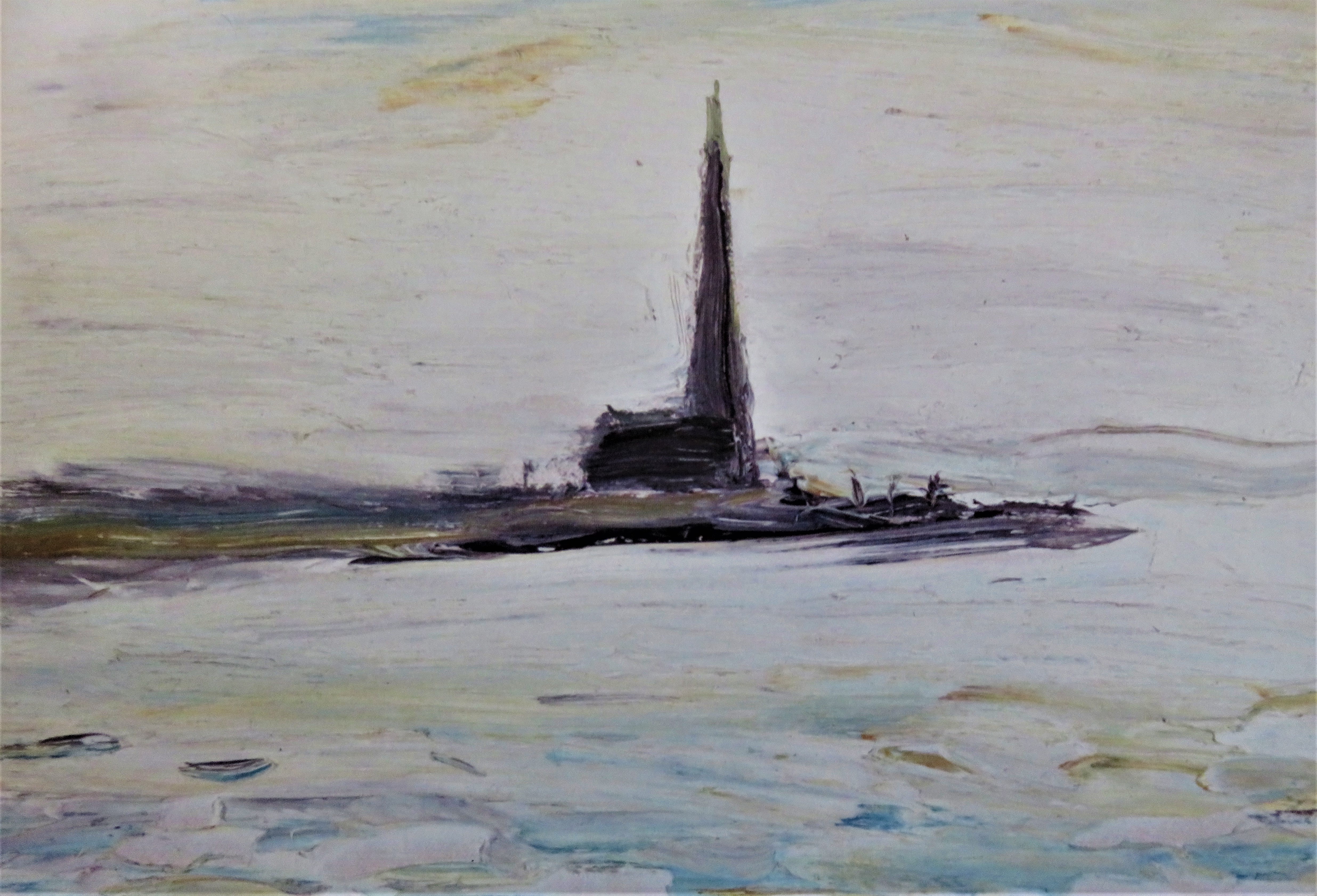
Newbiggin-by-the-sea 1966 oil on canvas. Private collection.

He would catch a train, taxi or a lift with friends up to Blyth, Berwick, Bamburgh or Newbiggin. Constantly drawn to the coast he would stare out to sea, and was inspired to use the sketches as a basis for oil paintings ’Don’t start thinking I was trying to put over some message, I just painted what I saw’.

Lowry was interested in St Peter’s Church in Monkwearmouth and seven mile away its twin monastery St Paul’s in Jarrow. Nearby in Bede Art Gallery he would meet Director, Vince Rea, and on a number of occasions enjoyed talking with amateur artists in the gallery.

St Paul’s, Jarrow 1962, pencil and ballpoint pen on paper. Private collection.

As mentioned in a previous post Lowry spent many hours at South Shields where the Tyne meets the North sea watching tugs, ships and fishing boats coming in. On the north side of the river is the notorious Black Midden rocks, before piers were built it was a graveyard for ships.

High up on the headland is Tynemouth Castle and Priory providing a dramatic backdrop. Lowry loved the scenery, the atmosphere, and above all, the sea.

He exhibited work at Newcastle’s Stone Gallery and became a friend of owner Mick Marshall. In later years he encouraged young artists to stay close to their roots rather than assume a move to London was necessary ‘No need to go to London to become a famous painter, you won’t find better lamp posts there’.

Sunderland Museum have an exhibition devoted to him and as a permanent reminder there is a Lowry Road and a new housing estate – Lowry Park, I think his mother would approve.

Gary Alikivi  December 2021

Notes:

L.S. Lowry by Michael Leber & Judith Sandling

L.S. Lowry in the North East published by Tyne & Wear Museums 2010.

LORD OF THE RING – in conversation with Sunderland boxing coach & fire fighter Preston Brown

The fantastic four of Tommy Hearns, Roberto Duran, Marvin Hagler and Sugar Ray Leonard were my era and I loved them. I’ve met Roberto Duran and Marvin Hagler and went to see Tommy Hearns box as he was my favourite. 

He was a great boxer, very skilful.

His fight with Marvin Hagler in 1985 is the most exciting three rounds of boxing. If Hearns boxed he would of won, but they both went at it hammer and tong and Hagler knocked him out in the third round remembers Preston.

Then every now and then you get a freak of nature like a Mike Tyson, he was powerful, had agility, and skill yes, but he was a fighter knocking people out. Boxing matches bring a clash of styles.

Today in the ring you have Anthony Joshua, Tyson Fury, Billy Joe Saunders who just fought for a world title, there’s still good boxers out there.

They came from amateur boxing but it’s not as popular as it used to be as there are more distractions now, kids can be in their bedrooms on their computers where parents can keep an eye on them.

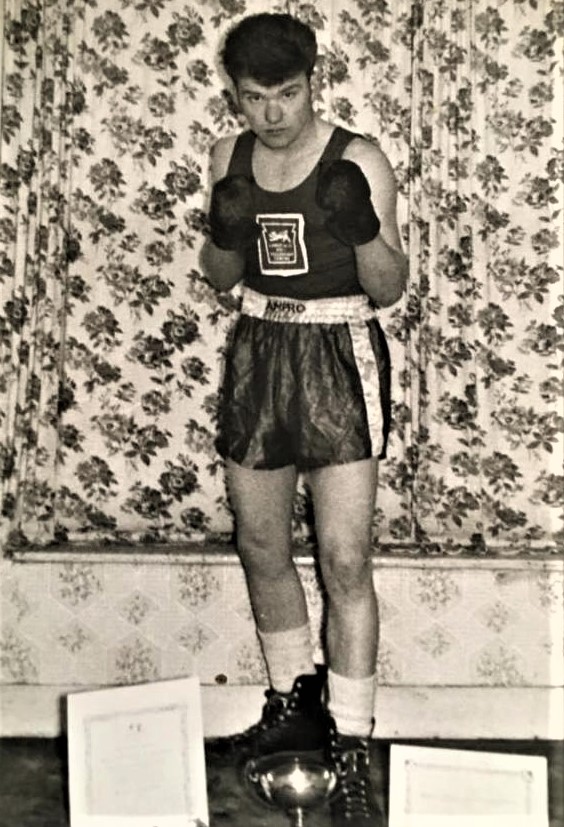
17 year old John ‘Pasty’ Brown.

FIRST ROUND

I was born and brought up in Hendon in the east end of Sunderland and my Dad, John, was a boxer. In the ‘60s a boxing club was opened and my Dad ended up coaching.

Through boxing he helped a lot of kids and hopefully I can do the same. Boxing can learn you discipline and respect – it can do a lot of good.

When I was young I was out in the street, bird nesting, playing on railway lines. But I drifted over to the boxing club with the other lads and my Dad was in there. I wasn’t forced into it. I’d sit ring side and took an interest in it.

What I’m doing now is a continuation of what my Dad did. Some kids when they first come in to the gym are not sure about it, but about 90% of them end up respecting the place, have determination and dedication to turn up training each week, and learn discipline. You’ve got to put the time in. It’s a tough game you can get hurt.

Preston in the gym.

IN THE RING

When I became a member of Sunderland Amateur Boxing Club I started boxing competitively through the ‘70s and ‘80s. I slowly progressed from boxing to coaching and become official through the A.B.A. (Amateur Boxing Association).

Sunderland lad Tony Jeffries was one of the gym’s proteges, he represented GB in the 2008 Beijing Olympics and won a Bronze medal.

At the gym with Tony was a kid called Stuart Kennedy, I thought he was a very good boxer, but just like in life, you’ve got to have a bit of luck. Stuart glided around the ring with his footwork but didn’t get the lucky breaks.

A kid called Anthony Wilkinson boxed with me, he won three British titles two years in a row and at 17 turned professional. I thought he was a bit young for it but he was making money. I think he could have been the best boxer we produced.

ALL FIRED UP

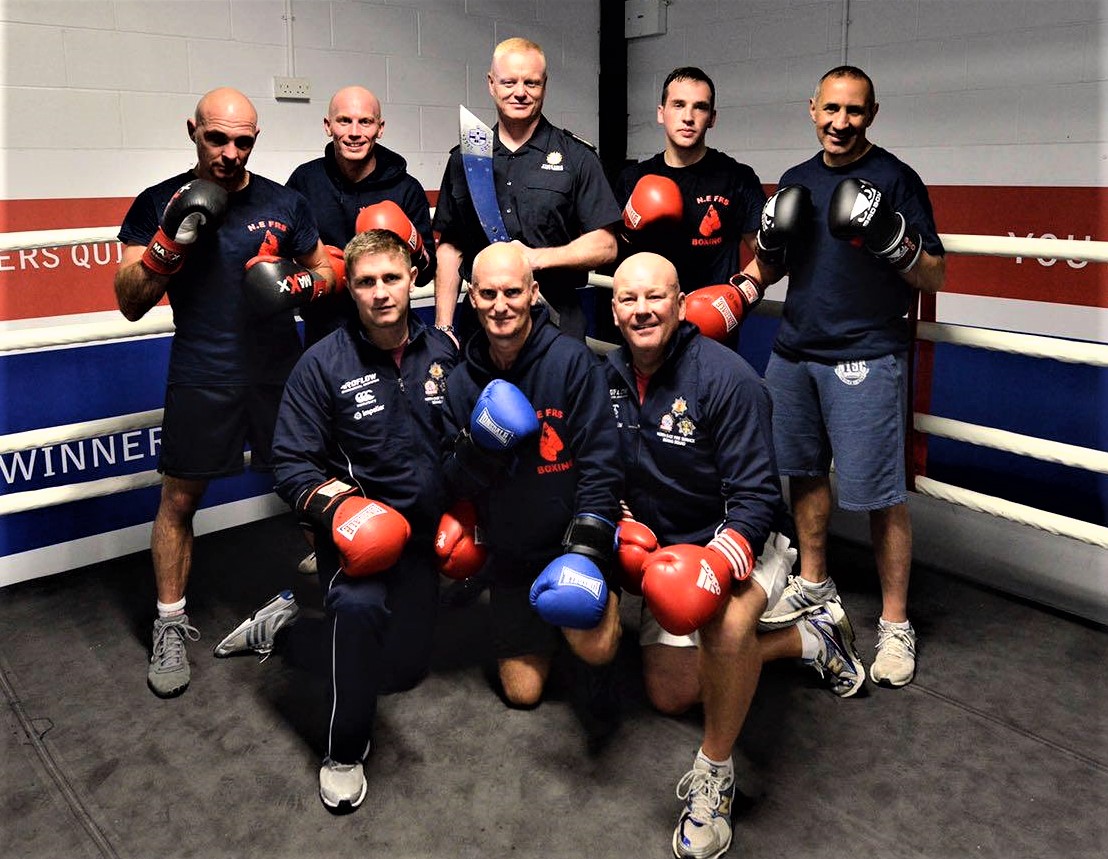
I got a job in the fire brigade, 22 year I’ve been in now, and there was a couple of firefighters who were boxers, they knew I had coaching badges so asked me to help out with some training.

We got on for a couple of year arranged a few charity matches with the police and then got invited to go over to Boston and Denver plus a small club in Ireland where we go annually.

The firefighters loved the boxing training and after using other gyms, with the total backing and support of Chief Fire Officer Chris Lowther, I set up our own in an old storage building in the Sunderland fire station grounds.

We got help with funds for equipment from the local council who said ok as long as you open it up to the community. We kitted the gym out with the best because the council were totally onboard with the whole idea and we had a big opening night in April 2019.

When we first opened the doors to the kids we were only getting a handful but that quickly grew to 35 a night so we extended to two hourly sessions. We got loads of kids off the streets.

The youngest is 9 year old when they train, you can’t box until you’re 11. From 11 to 15 you’re a schoolboy, 15 to 17 classed as a junior, at 17 you can box men. My first senior fight was at 17 the other lad was 34. I got beat but we’re still good friends (laughs).

I was classed as a boxer not a fighter, I had boxing skills with my feet, hand speed and technical ability. I boxed him in the first round, dancing round him you know.

Second round he thought it was time to slow me down and hit me with a body shot and knocked me down I had a standing count of eight to compose myself. That’s the difference between a boy and a man.

Kids start off at three rounds of a minute and a half, as you get older you go to two minute rounds and seniors box three minute rounds.

Our gym aims to channel the energy of young kids, it gets them interacting with people, better than them playing on their phones.

CREATING CHAMPIONS

We’d love to produce Olympians or World Champions but if they come out just feeling better about themselves we’ve won. In the gym we’ve had police officers mixing with criminals, different people who wouldn’t normally get on but who’ve got a love of the sport.

The atmosphere is fantastic everybody loves it and you can forget about what is happening outside – like being in a bubble.

There’s no better feeling in the world when the referee holds up your hands to say ‘and the winner is’. In the same breath if you get beat by the better man you think ‘I’ll do better next time’.

The fire lads and the kids have a thing where they say, ‘I didn’t win that fight, but we learnt from it’. And that’s important because it’s all about competing. The gym’s motto is creating champions in the ring, creating champions in life.

Anyone that can step in the ring has my total respect. You’re stepping into the unknown, the man across from you might be better. So, have you done enough training ? Have you worked with the coach enough ?

You will be put in the ring against someone with similar experience.

Although our club has fought against a team that’s put in ringers – fighters with a lot of fights – matched against someone with only two or three. That’s not on really, it’s about giving the lads a proper fight, they’ve got to be matched up correctly.

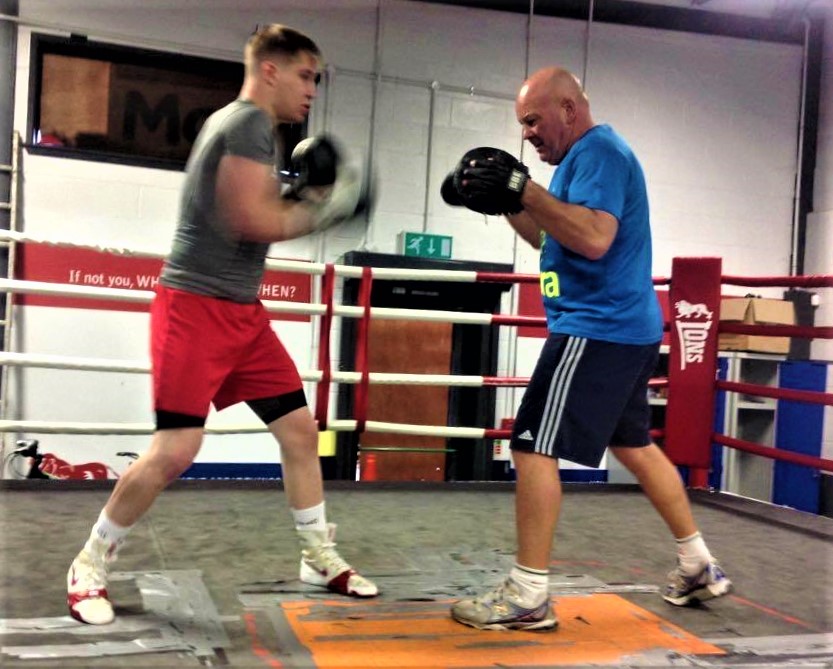
Preston coaching in the gym.

HEADS UP

Head guards were brought in a few years ago and the kids and females need to wear them but the bigger lads can agree to wear them or not. I’m a big believer in them when you are training but they are uncomfortable to wear when competing.

I will insist on everyone wearing one when sparring and training. The women may not be big and powerful as the lads but they are very skillful and I appreciate that, it’s an art.

PROGRESS

Britain has produced some good boxers over the years who have come through amateur gym’s but in the past year covid has restricted that so it’s a problem, we’ve got to work something out to go forward and make progress.

For more information contact Preston on: 07740 285 966

Sunderland Central Fire station, Tyne & Wear Fire & Rescue Service,

Phoenix building, Railway Row, Sunderland SR1 3HE

Gym address: Unit One, Westbourne Road, Sunderland SR 1 3SQ

Interview by Alikivi   August 2021